

AI/ML PhD Thesis Help in India: Where Scholars Actually Get Stuck
Artificial intelligence and machine learning are currently some of the most popular — and most oversubscribed — PhD research areas in India. That popularity creates a specific problem: reviewers and evaluation committees have seen hundreds of “novel deep learning model for X” proposals, and generic approaches get filtered out fast
Having supported scholars working in AI/ML across engineering colleges and universities in India, we’ve noticed the bottlenecks cluster around a handful of predictable stages. This guide addresses each one directly.
The single most common issue we see in AI/ML proposals is a research gap that’s already been addressed — often within the last 12–18 months, given how fast this field moves. A literature review that’s six months old can already be outdated.
What helps: Before finalising your topic, search recent conference proceedings (NeurIPS, ICML, CVPR, and relevant domain-specific venues) in addition to journal databases. Conferences publish faster than journals and reveal where the field is actually heading.
A theoretically strong proposal can stall completely if the required dataset isn’t available, is too small, or requires computational resources beyond what your institution provides. This is especially common in medical imaging, NLP for regional languages, and federated learning research.
What helps: Confirm dataset access and realistic compute requirements before your synopsis is approved, not after. We’ve seen scholars lose a full semester redesigning their methodology because a dataset assumption didn’t hold up.
Reviewers increasingly expect AI/ML methodology sections to be reproducible — meaning hyperparameters, train/test splits, evaluation metrics, and baseline comparisons need to be explicit, not vague. “We trained a CNN and achieved good accuracy” is a common early draft; it won’t survive review.
A pattern we see often: strong technical work undermined by writing that overstates results relative to the actual experimental scope. Reviewers notice this quickly, and it damages credibility more than a modest, honestly-framed result would.
What helps: State results in the context of your specific dataset and constraints. Acknowledge limitations directly — it strengthens the paper rather than weakening it.
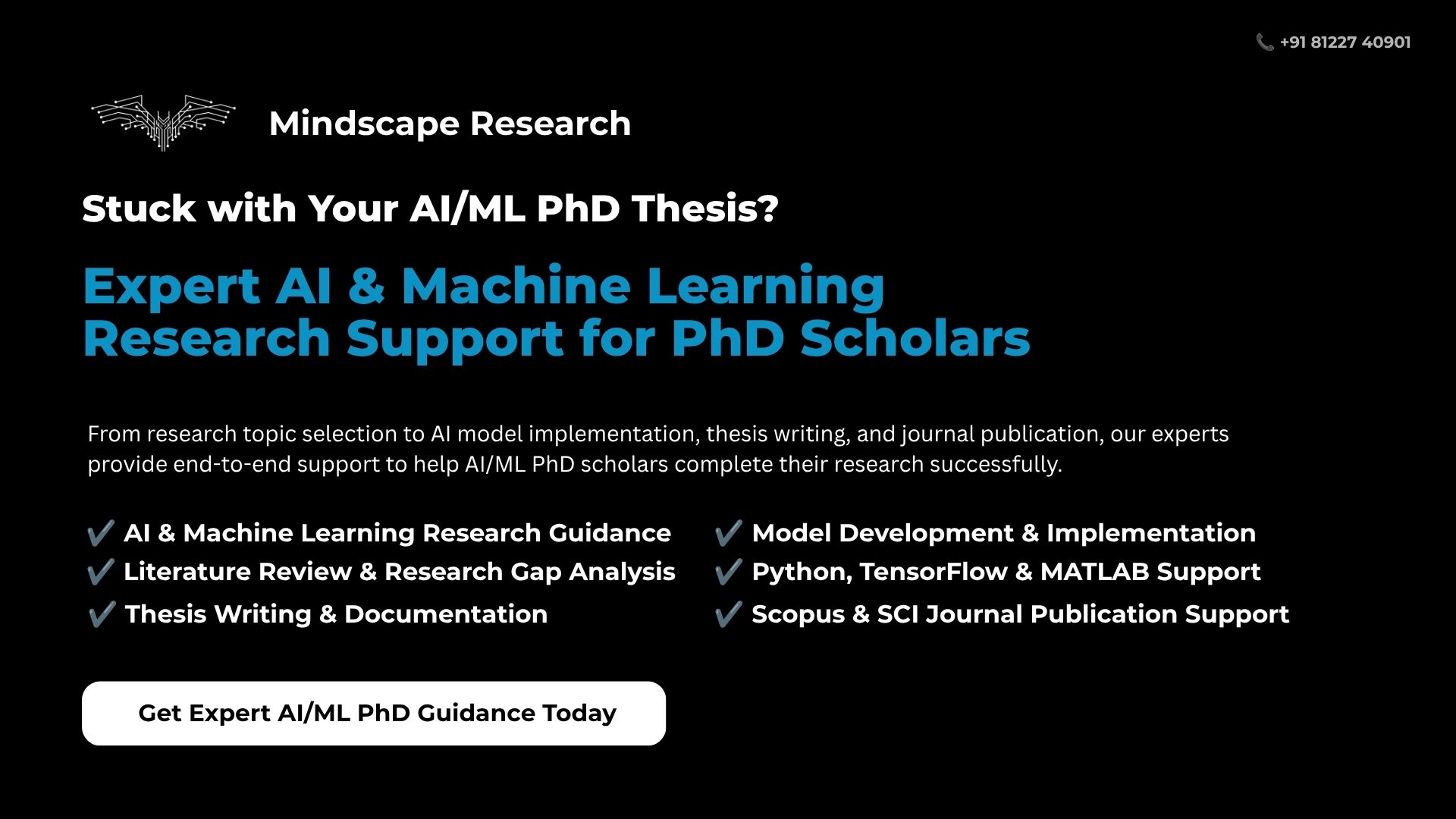
Our technical team works with PhD scholars on:
- Literature review and gap identification across recent conference and journal sources
- Implementation support (Python, TensorFlow, PyTorch) for methodology validation
- Structuring methodology and results chapters to reproducibility standards
- Journal/conference shortlisting suited to AI/ML subfields
We work alongside your guide’s direction – our role is to help you execute and structure your research clearly, not to replace your own analytical work.
Working on an AI/ML thesis and stuck on methodology or implementation? Talk to Mindscape Research for a free technical consultation.
How to Get Started with Mindscape Research
Getting started is straightforward:
1. Visit: www.mindscaperesearch.com
2. Call/WhatsApp: +91 81227 40901
3. Email: Support@mindscaperesearch.com
4. Schedule a Quick Call or Request a Demo through their website
5. Discuss your research needs with their expert team
6. Receive a customized research assistance plan
Leave a Reply