


- PhD implementation help research implementation support
- PhD project execution
- MATLAB PhD help
- Python research implementation
- PhD software implementation
What is PhD implementation help?
PhD implementation help refers to expert-guided support that helps doctoral students translate their theoretical research framework into working software models, simulations, and verifiable results. It covers the full technical pipeline — from choosing the right platform (MATLAB, Python, NS3, VHDL, etc.) to building accurate models, running simulations, evaluating outcomes, and producing publication-ready documentation.
Unlike general academic coaching, PhD project implementation support is domain-specific and hands-on. It bridges the gap between your research proposal and the actual executable outputs your committee, journal, or institution expects to see.
“Most PhD students do not fail because of their ideas. They fail because they cannot implement them. That is exactly the gap implementation support is designed to close.”
The demand for PhD implementation help has grown significantly as doctoral research has become more technically demanding. Most research programs today require candidates to produce software simulations, data models, or hardware implementations — often without formal training in the tools involved.
Our approach to research implementation support for PhD students is built around a four-stage process designed to keep your research goals front and centre at every step.
- 1Requirements analysisOur team thoroughly reviews your study scope, research objectives, and institutional requirements before any implementation begins. This ensures the technical approach is perfectly aligned with your academic goals.
- 2Patent and originality verificationBefore a single line of code is written, we verify that your implementation approach is patent-compliant and original — protecting you from compliance issues down the line.
- 3Model building and simulationOur specialists build accurate models using the most suitable software for your domain, run full simulations, and evaluate outcomes — providing clarity at every stage of your PhD project execution.
- 4Documentation and publication readinessWe produce annotated code, detailed implementation reports, and all supporting documentation needed for thesis submission, journal publication, or institutional review.
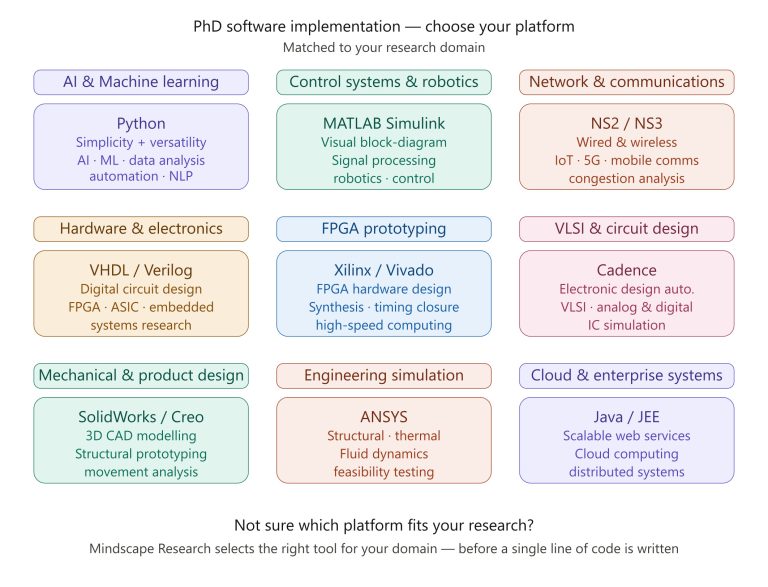
PhD software implementation: choosing the right platform
One of the most common questions we receive from students seeking PhD software implementation help is: “Which tool should I use?” The answer depends entirely on your research domain. Here is a practical overview.
A technically perfect simulation built on weak data produces weak results. When PhD students seek implementation help for their PhD projects, data sourcing is often the most overlooked step — and the one that most frequently causes problems at the examination stage.
For civil engineering and environmental research, Mindscape Research provides real-time, field-collected data to ensure authenticity. For other technical domains, we supply structured datasets that simulate real-world conditions with fidelity — giving your models the foundation they need to produce defensible outcomes.
Who benefits most from PhD implementation help?
- Students in engineering, computer science, electronics, and IT facing software-heavy research requirements
- Candidates whose supervisors are domain experts but not software implementation specialists
- Researchers working across platforms they have not formally trained in
- PhD students facing tight submission deadlines with incomplete simulations or models
- International doctoral candidates navigating both language and technical barriers simultaneously
Frequently asked questions about PhD implementation help
Get expert PhD implementation help today
Talk to a Mindscape Research specialist about your project — platform selection, data sourcing, simulation, and documentation all covered.
Court Road, Kuzhithurai, Marthandam, Tamil Nadu
📞 +91 81227 40901
✉️ mindscaperesearch@gmail.com
Leave a Reply