
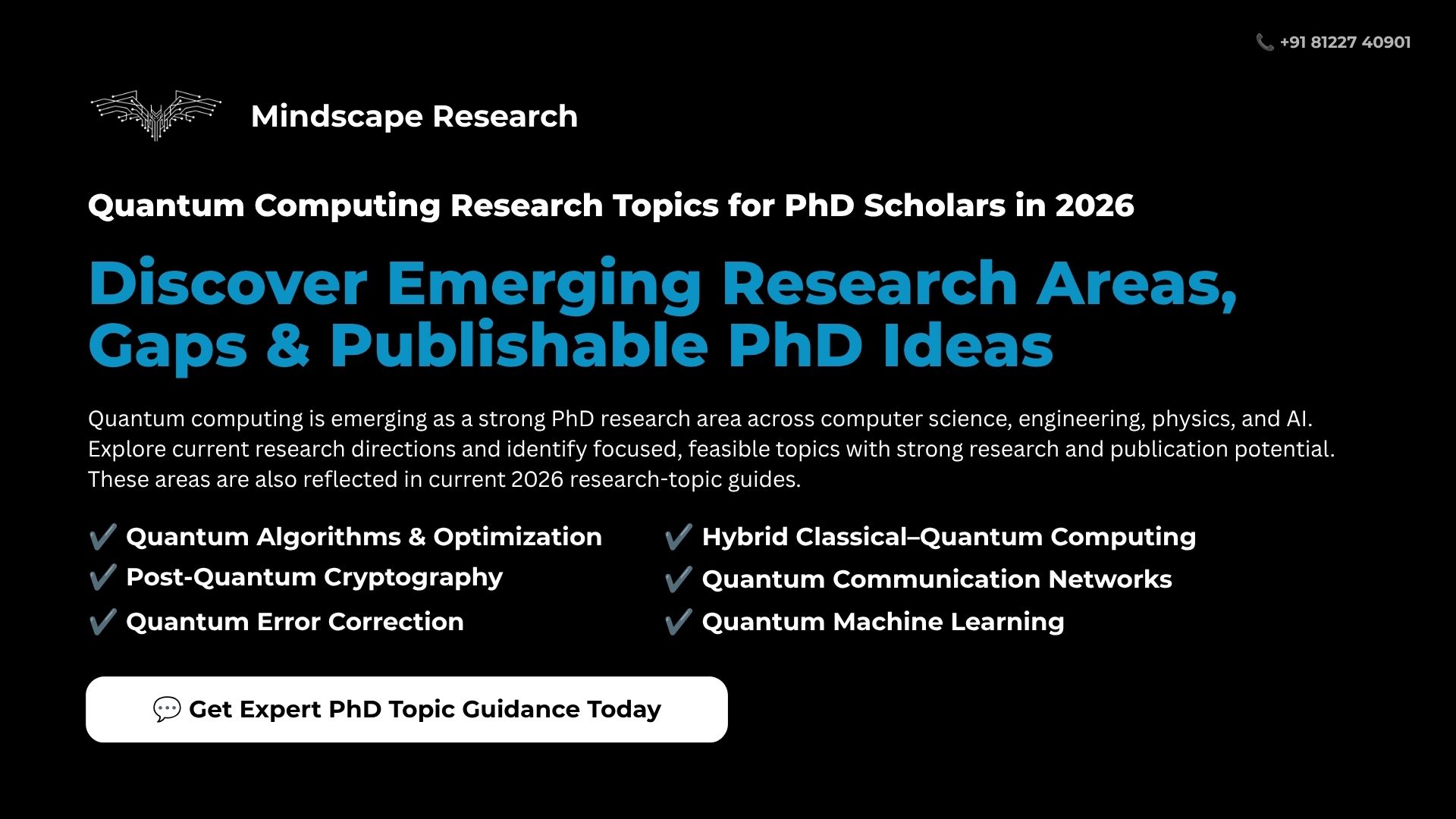

Quantum Computing Research Topics for PhD Scholars in 2026
Quantum computing has moved from a theoretical curiosity to one of the most activeresearch areas in computer science, physics, and engineering. For PhD scholars trying topick a dissertation direction, the challenge isn’t finding a topic – it’s finding one that’s narrow enough to be doable, current enough to be publishable, and aligned with what your department or supervisor can actually support (hardware access, simulators, funding).
This guide breaks down where the active research gaps are right now, and how to turn a broad interest in “quantum computing” into a defensible, well-scoped PhD topic.
Quantum computing sits at an unusual stage: the theory is decades old, but practical hardware is still young enough that there’s room for genuine contribution without needing a physical quantum computer of your own. Most PhD work in this space happens on simulators, hybrid classical-quantum models, or algorithmic/theoretical contributions- which makes it accessible even for scholars without lab access to real quantum hardware.
It also intersects with almost every other research domain – cryptography, machine learning, chemistry, optimization – which gives you flexibility to angle your research oward a committee or department that’s stronger in one of those adjacent areas.
1. Quantum Machine Learning (QML)
How classical machine learning models can be redesigned to run on quantum circuits, or how quantum-inspired techniques can speed up classical ML. This is one of the most active sub-fields right now because it doesn’t strictly require full-scale quantum hardware- much of the work happens on quantum simulators or small noisy quantum processors.
Possible angles:
- Quantum neural networks for classification tasks
- Hybrid quantum-classical optimization for training ML models
- Benchmarking QML against classical baselines on real datasets
2. Post-Quantum Cryptography
As quantum computers threaten to break widely used encryption schemes (like RSA), there’s significant research demand in designing and evaluating cryptographic systems that remain secure even against quantum attacks. This is a good fit for scholars with a cryptography or security background who want to future-proof their research.
3. Quantum Error Correction and Noise Mitigation
Current quantum hardware is “noisy” – qubits lose their state quickly, and errors accumulate fast. Research into error-correcting codes, noise mitigation strategies, and fault- tolerant quantum computing is one of the most cited areas in the field, because it’s the bottleneck standing between today’s hardware and practically useful quantum computers.
4. Quantum Algorithms for Optimization Problems
Many real-world problems (logistics, scheduling, finance) are optimization problems that are computationally expensive for classical computers. Research into quantum algorithms (like QAOA – Quantum Approximate Optimization Algorithm) that could offer speedups for these problems is an active and practical research direction.
5. Quantum Simulation for Chemistry and Materials Science
Simulating molecular and material behavior is one of the areas where quantum computers are expected to eventually outperform classical ones. If you have a chemistry, physics, or materials science background, quantum simulation research bridges your domain expertise with computing.
6. Hybrid Quantum-Classical Computing Architectures
Since full-scale, fault-tolerant quantum computers are still years away, a lot of practical research focuses on how quantum processors can work alongside classical systems – dividing computational tasks between the two to get real value out of today’s limited quantum hardware.
A broad label like “quantum computing” won’t survive your first committee review. To scope it properly:
- Pick a domain intersection – quantum + ML, quantum + cryptography, quantum + chemistry – rather than quantum computing in isolation.
- Check hardware/simulator access – confirm whether your university or department has access to quantum simulators (like Qiskit, Cirq, or cloud-based quantum processors) before committing to a topic that assumes hardware you can’t reach.
- Look at recent publication trends – search recent papers (last 2-3 years) in your chosen sub-area to confirm it’s still an open problem and not already saturated.
- Talk to your supervisor early – quantum computing spans physics, CS, and engineering departments differently; your supervisor’s background will shape what’s realistically supervisable.
Final Thoughts
Quantum computing offers PhD scholars a rare mix of theoretical depth and real-world relevance, but success depends on choosing a specific, well-scoped sub-area rather than trying to tackle “quantum computing” as a whole. Whether you lean toward quantum machine learning, cryptography, error correction, or simulation, the key is aligning your topic with both current research gaps and the resources available to you.
If you’re still weighing between sub-areas or need help structuring your research proposal around one of these topics, our team at Mindscape Research works with PhD scholars across India on topic selection and proposal development.
How to Get Started with Mindscape Research
Getting started is straightforward:
1. Visit: www.mindscaperesearch.com
2. Call/WhatsApp: +91 81227 40901
3. Email: Support@mindscaperesearch.com
4. Schedule a Quick Call or Request a Demo through their website
5. Discuss your research needs with their expert team
6. Receive a customized research assistance plan
Leave a Reply